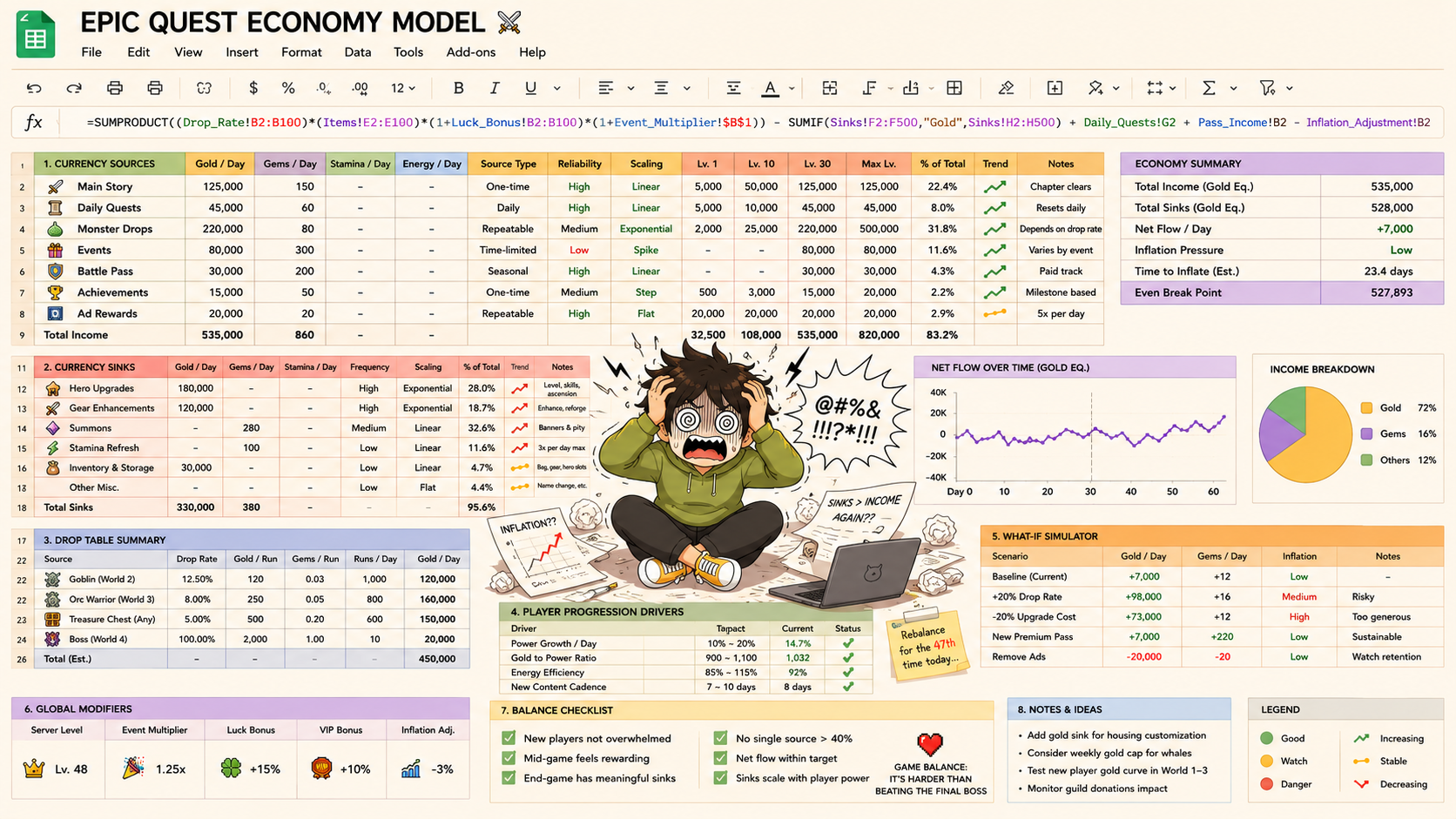
Every designer has been lost in a balancing spreadsheet at some point. The problem usually isn’t the numbers, it’s knowing what you’re actually trying to balance. This article walks through the process I’ve built to avoid that trap.
Know What You’re Balancing
The first step is to identify the parameters you’ll have to tweak, which is not as obvious as it sounds.
first order parameters – what’s written down
Start by listing all the numerical parameters that are written in your design document detailing how the feature works. They can be anything from an attack cooldown, a movespeed, an amount of resource or a drop rate.
These are what I call first order parameters, the simplest ones to identify as they are directly visbile in your design document.
Example
Let’s say you’re balancing a simple progression system in which players earn XP when defeating enemies. When they have enough XP, they level up.
The first order parameters of this system are:
- XP dropped by each enemy type
- XP required to level up, for each level
Second order parameters – your creative frame
Some parameters come from the creative vision of the game you’re building. They are not to be tuned directly yet play a crucial role in determining the right values for any parameter you need to tune.
Identifying these parameters requires to think about your game design philosophy and often leads to interesting alignement talks with the creative direction and other leads.
Example
If the player fights 10 of the same enemy archetype, they’ll earn 10 times what they would earn when fighting 1 enemy. It means the number of XP you’ll give when defeating enemies highly depends on the number of enemies per combat, which comes from your design philosophy. A musou won’t have the same philosophy when it comes to XP per enemy than a souls-like game. At a larger scale, it also depends on the number of arenas a typical section of your game includes.
The amount of XP you’ll give also depends on how much you want the player to farm before they level up. If your design philosophy is that players must complete each mission twice to progress in your game, you’re likely to give twice less XP than if you want them to complete each mission only once.
This type of parameters is what I call second order parameters, they come from the creative vision of the game and must be accounted for. Identifying those will allow you to save time and make sure you stay within the creative brief.

Third order parameters – what players actually feel
Players don’t experience numerical values, they experience relationships between the values of the different parameters of a system.
Identifying the parameters that have the most direct impact on your game will allow you to define which values you’ll set manually and which ones you’ll compute.
Example
When players earn XP, what they care about is not really the amount of XP they’ve earned, it’s how often they level up. Behind the XP drops and the required amount of XP to level up, what actually matters is the number of level up per hour, or per mission depending on the structure of the game.
The number of level up per hour is what I call a third order parameter. It’s a parameter that is not directly visible in your design document but which is the most impacting on the player experience.
These third order parameters are what you should be balancing for. In a progression system, you’ll be balancing XP drops and the amount of XP required to level up in order to get the number of level ups per hour or per mission right. In a combat system, you’ll tweak health, attack and defense values in order to get the number of hits to defeat each enemy right.
Set Your Design Goals First
Write design goals in plain text
Balancing is often misread into something about fairness, equal opportunites, which in a sense is right. But most of all, balancing numbers must serve the designer’s goals.
Before jumping into your favorite spreadsheet software, look at the third order parameters you’ve identified and set design goals.
For instance, let’s say you’re balancing the classic progression system we’ve mentionned earlier. One of your design goals could be “The player should level up once per mission”.
Meeting these goals is what your time digging into cells should lead to, it’s the experience you’re trying to build. Every value you’ll chose must contribute to achieving these goals.
Write these design goals in plain text in a highly visible part of your spreadsheet. This will allow you not to lose track of what you’re trying to achieve and will make it easier to communicate wih other designers if you need to onboard someone else.
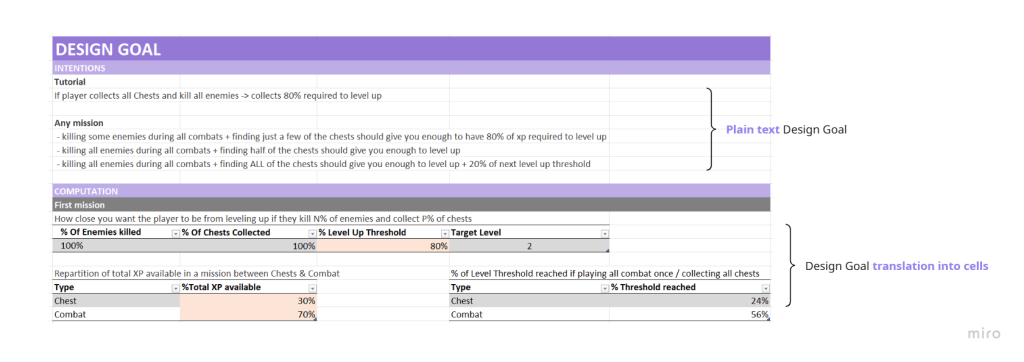
map the relationships between parameters
Most parameters are connected to one another. These relationship mostly come from your design goals.
Saying that you want the player to level up once per mission creates a relationship between XP earned during a mission and the XP required to level up. To meet this design goal, you need:
If you’re working on a combat system, saying that you want the player to defeat a given enemy in 4 hits results in a relationship between the health of the enemy and the attack of the hero:
These relationships are the building blocks that will allow you to make computations and pick the right values to meet your goals.
Know What to Set Manually vs. Compute
Knowing which values you have to manually set and the ones you’ll compute is a case by case solution, but there are still a few helpful guidelines to follow.
values shown to the player are often best to set manually
If you show a value to the player, it’s probably best to set it manually to avoid ending up with numbers that are difficult to use as a player. If you need to compute it, make sure to round the value so it’s easily legible.
If the value is shown for a short duration, like a damage output for instance, it’s even more important to make sure it’s easy to grasp as players must be able to read it in a short timespan.
do yourself a favor by computing as many cells as possible
When balancing your game, you will manually tweak some values and compute some others. Try to manually set as few values as possible, it’ll save you some time as you’ll have less cells to edit.
don’t be a slave to your formulas
Make sure to build your spreadsheet in a way that allows you to easily override any computed value. Computing values saves time, but in a lot of cases you want to be able to control the outcome. Overriding a value might be useful to round it to a number that will be easier to read or even to control the pacing of the evolution of a given parameter.
it’s okay to experiment
It’s alright to not make the best call here. Making a good choice will allow you to save time and be more efficient, but in the end whether you manually set or compute a value gives you the same result as long as you respect the relationships between parameters.
You don’t have to know everything before jumping in Excel. Actually in most situations, building the Excel file will help you think about who you want to compute and who you want to manually set.
Build a Model of How Players Play
Identifying third order parameters require to think about how player experiences the game, which often requires modeling the experience.
Your goal here is not to accurately describe everything that can happen when someone plays your game, this would be a daunting task. Your goal is to model the game in a way that’s accurate enough for you to make computations that allow you to meet the design goals you’ve set.
Start simple and make the model grow if you see you need more granularity as you go.
Simulate Player Behavior Before Testing
Running simulations is important to have an initial feel of how the system will behave under different circumstances.
PLAyer traits
I often break down what players do in the game into different traits that will then define a behavior. These traits are mostly based upon my model of the game experience and is a case by case scenario.
Let’s say we’re balancing an economy of XP. Depending on your systems, players might be able to keep XP upon respawning, skip fights, farm enemies, and explore to find chests. All these possible behaviors define traits that can be translated into cells.
Then, for each trait, we can define variants depending on which value we assign to this behavioral trait.

building imaginary PLAYERS
Combinining traits allows us to create players. One might never farm and find all chests, another might farm each combat twice and find none… every combination is allowed.
I usually look at a few scenarios that I think are the most likely to happen, as well as the most extreme scenarios, thinking that what players will actually experience will be somewhere between these boundaries.
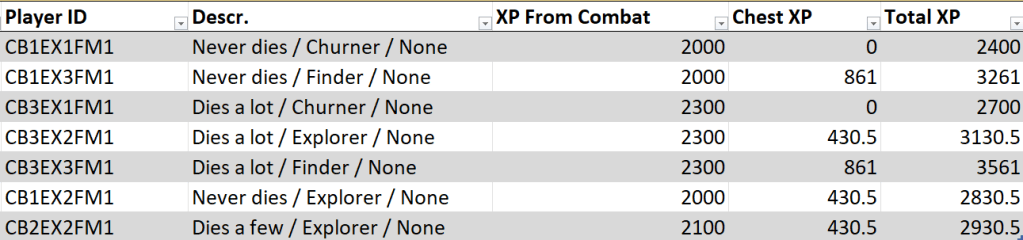
These players will earn more or less XP compared to a player that never dies, never farm etc, which will allow you to run simulations.
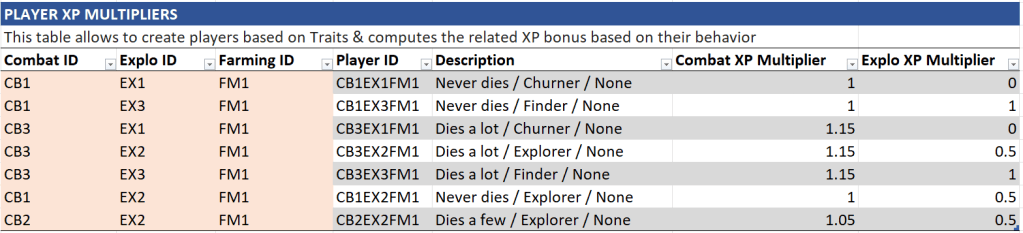
use imaginary players to simulate player paths
Thanks to the fake players, you can compute how much extra XP each behavior leads to and check if that feels right with your design goals you’ve defined earlier.
Test, Play, and Trust Feedback
Testing is key
Modeling and simulating is important to check several behaviors, but the real deal takes place in the game.
Test for yourself to see if the values feel right when playing, and get as much feedback as possible from players or team members.
game balance is not only about numbers
Keep in mind that game balance is not only a matter of numbers, but also comes down to how these numbers are translated in the game. How do players feel these values that you’ve picked? Something that is reported to you as a balancing issue might in fact be a sound or visual element not conveying accurately the values you’ve defined.
Always dig the feedback as much as possible and wonder about the causes of the issue before iterating on your values.

Leave a Reply