
A Story of Numbers
As players progress in the game, they fight more challenging enemies who are likely to require more hits to be killed. It means late game weapons need to have a greater durability than early game weapons but at the same time, as a designer, you don’t want players to carry these late game weapons to early game areas and crush monsters too easily, which means their durability must not be too high.
How to balance weapons to encourage players not to use high damage ones on low health point (HP) enemies? Is it really beneficial not to always use high damage weapons?
Methodology
To understand how weapon damage and durability values are balanced, I’ve compared the durability a player would lose when killing an enemy using a low attack weapon and the durability they would lose by killing the same enemy using a high attack weapon.
To achieve this goal, I’ve built a model of what a low attack and a high attack weapon would be, as well as what a low HP and high HP enemy would be. I then used these models to compare each scenario.
DATA SOURCE
I’ve used the data from the game’s wiki and from a post by OneOf99 showing the HP of each enemy. I’ve removed every enemy that are exclusive to the Master Mode game as well as every weapon earn by using Amiibos.
This article is focused on melee combat, it doesn’t cover bows and shields.
Many thanks to the community for giving access to this data!
Building Weapon Archetypes
grouping weapons by attack power
As mentioned in the first part of this series, weapons have two attributes: Attack and Durability.
I’ve started by splitting weapons in 5 tiers based on their Attack.
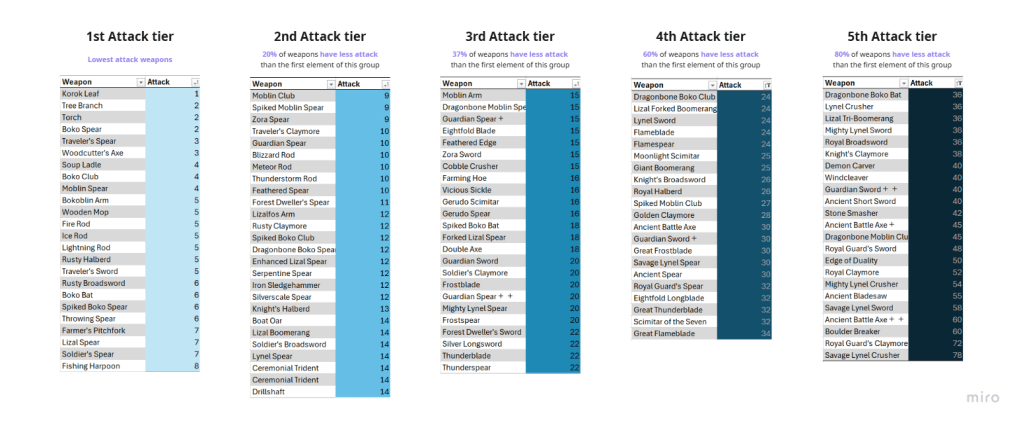
defining Weapon Archetypes
For each attack tier, I’ve computed the average attack and the average durability. I then created 5 weapon archetypes using these values as attributes:
| Weapon ID | Attack Tier | Average Attack | Average Durability |
|---|---|---|---|
| Weapon #1 | 1 | 4.71 | 15.67 |
| Weapon #2 | 2 | 11.73 | 27.38 |
| Weapon #3 | 3 | 17.96 | 27.50 |
| Weapon #4 | 4 | 28.05 | 34.67 |
| Weapon #5 | 5 | 47.70 | 31.35 |
Building Enemy Archetypes
cleaning the data: which enemies were left
As I wanted to focus on base enemies, I’ve excluded mini-bosses, bosses and any enemy that is exclusive to the Master Mode. I’ve also removed any enemy that is meant to be killed doing something special like destroying a Malice cluster.
Keeses are also excluded. They are 1 HP bat-like monsters who always come in pack. It means you have to swing as many hits as there are bats to kill them all, which severely chunks your weapon’s durability. Keeses are low HP enemy that have a big impact on weapon durability, which is not standard. Considering them as standard enemies would have lowered the average HP of enemy tier 1 in an unfair manner.
defining Enemy archetypes
Similar to what I’ve done for weapons, I’ve split enemies into 5 tiers based on their HP and computed the average HP within each tier.
| Enemy ID | Enemy Tier | Average Enemy HP |
|---|---|---|
| Enemy #1 | 1 | 8.78 |
| Enemy #2 | 2 | 20.50 |
| Enemy #3 | 3 | 52.86 |
| Enemy #4 | 4 | 159.14 |
| Enemy #5 | 5 | 303.43 |
Durability in Numbers
setting up the SCENArios
Now that we have weapon and enemy archetypes, let’s have a look at the percentage of durability lost when players fight each enemy archetype with each weapon archetype:
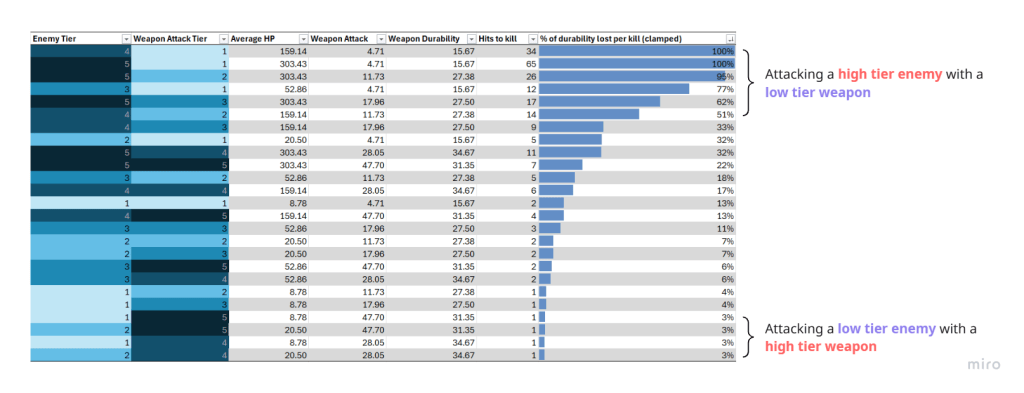
using low tier weapons is punished
Players lose the most durability when attacking a high HP enemy with a low attack weapon. In most cases they can’t even kill their enemy without breaking their weapon. This result is expected as in such situations they need to land a lot of hits on their enemies to defeat them.

This forces players to explore the world to find better weapons if they want to reduce the frustration of breaking their weapons apart.
high damage weapons: a great single-use tool
On the opposite, attacking a low HP enemy with a high damage weapon only takes a few percent off their durability and ranks amongst the most beneficial situations.

This allows players to benefit from using a high damage weapon on a low HP enemy when they want to make their life easy without being too harshly punished for it.
But most fights have the player facing 4 to 5 enemies at once, a bit fewer than that in the early game, a bit more than that later on. This means high damage weapons lose about 15% to 20% of their durability when completing a low tier fight and are broken in about 5 to 6 fights.
I think it’s a pretty clever philosophy, it allows players to smash monsters here and there but if they do that for a few fights in a row they’ll likely regret it.
the hidden trade-off
To understand how Breath of the Wild achieved the results seen above, I had a look at how Durability evolves in each Attack tier.
I’ve taken all weapons and split them in 5 tiers based on their Durability. I’ve color coded Attack and Durability tiers following the same code.

We can see that there are more dark areas in the Durability column of each table as the Attack tier increases, which means there are more high durability weapons in high attack tiers than in low attack tiers. But there are still quite a lot of light cells in high attack tiers, as well as quite a few darker cells in the low attack tiers.
When looking more closely, we notice that almost 50% of weapons in the 4th and 5th Attack tiers have a 3rd tier or lower Durability.

This allows high damage weapons not to be cheat codes. A few of them have a top of the class attack as well as a top of the class durability, but most of them break in a few fights. This way, players still benefit from having weapons that can endure fights against high HP enemies but still break quite fast if used against several early game arenas.
WEAPONS BREAK MORE EASILY AS THE GAME PROGRESSES
Assuming that enemies in a given HP tier are meant to be fought using a weapon in the matching attack tier, we can compare the importance of the durability mechanic over the course of the game.

Attacking a tier 5 enemy with a tier 5 weapon consumes much more durability than attacking a tier 2 enemy with a tier 2 weapon. In fact, the durability lost always increases* as players fight more resistant enemies. Taking into consideration that fights include more enemies in the late game than in the early game, players can see their weapons break way faster when fighting late game enemies.
My guess is that it’s meant to guide players into varying how they approach combat throughout the game. In the early game, players are not familiar with the systemic reactions they can use. As a result, they’re more likely to rely on melee combat to defeat their foes. As they progress, they’re meant to use more elemental components of the game and special abilities. By having weapons break more easily in the late game, the game tries to push players not to use weapons too much.
A further analysis could look at how enemy tiers are distributed along player’s journey to see how often players are meant to face each enemy tier.
*Weapon Attack Tier 1 includes dull weapons such as tree branches and tree leaves that have a very low durability, thus increasing the kills per hit and thus durability lost.
The Importance of Not Knowing
The steps I’ve taken approached the matter through the lens of the Attack value of weapons instead of looking at their Durability first. This is not an arbitrary choice.
When looking at weapons in their inventory, players can see their Attack value but can’t see how much Durability they have. Icons become red when they’re about to be broken, but the exact value is nowhere to be seen.
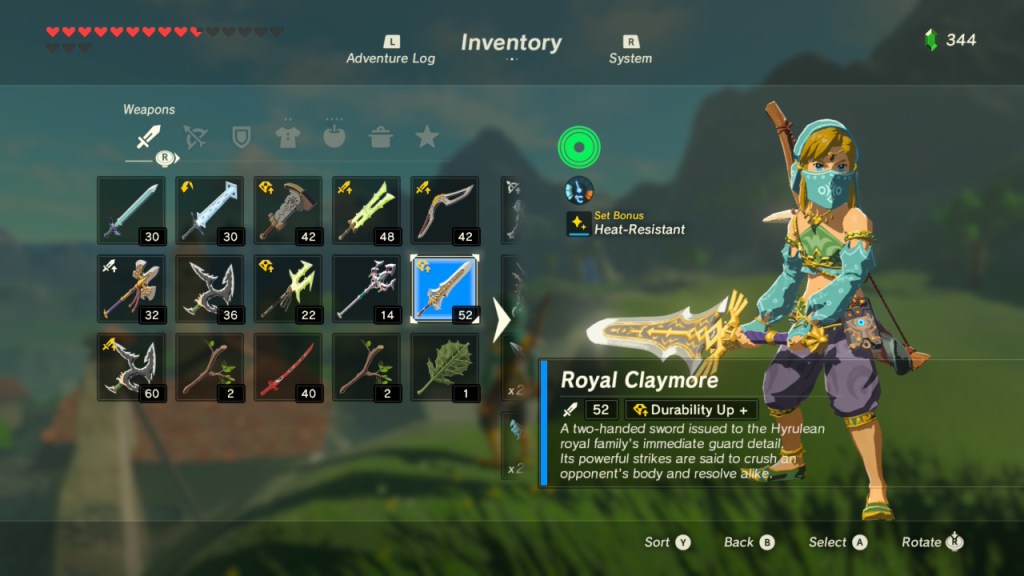
If players knew the weapon Durability values, they could see that some weapons perform well both in terms of damage and durability as we’ve seen earlier. They could try and find these weapons, carry them from an area to another and smash early game monsters.
Players would also be more likely to use a high damage weapon with a high percent of remaining durability on a low HP enemy. It’s actually because they can’t make informed decisions regarding their weapon durability that they can be willing to switch to a lower attack weapon to save the better ones for more difficult fights.
Not knowing how much Durability weapons have is a cornerstone of how the game drives players to self manage their difficulty.
Besides, it also creates unpredictability which makes fights more dynamic, and reduces time spent in menus.
Your Mileage May Vary
Players dynamically switching weapons to adjust the difficulty to their own taste highly depends on how valuable they think high attack weapons are.
Players who don’t mind spending time in areas they’ve always been to in order to get some new copies of weapons they like, and players who are not loss averse are more likely to keep using high damage weapons even on low difficulty enemies.
A lot of players disliked the durability mechanics in the latest Zelda games, but I’d love to get playtest data to know how it shaped their behavior.
Leave a Reply